Showing posts with label Le Creuset. Show all posts

Sunday, June 10, 2012

Lasagna Is Not an Appropriate Summer Dish


“Why are you making lasagna when it’s 9 billion degrees outside?” tweeted @amycrea, a tweeple who has become an IRL friend. (And who ought to know better than to ask.)

Why? Why?? What do you mean, “why?”
  • I got a new blue Le Creuset earthenware pan for my birthday! Yay! Now I’m feeling adventurous!
  • I read an article about lasagna on Slate.com in a series called “You’re Doing It Wrong.” Nothing pisses me off more than being told by Internet hipsters that I’m doing something wrong. Plus, for someone who’s telling everyone they’re doing it wrong, the author holds a rather shallow understanding of what makes a good tomato sauce. Rrr! Now I’m feeling vindictive!
  • I have promised to bring dinner to my friends Deb and Sean, who are new parents. Now I’m feeling all protective.
So add it up: if you had the whole clear blue sky before you; and THEN you had to one-up someone; AND you could feed it to your loved ones—well, doesn’t that equal lasagna? Weather be damned!

Ridiculous, Ridiculous, Ridiculous
I followed Slate’s suggestion and made mushroom lasagna, except they don’t know what they’re doing so I fixed their recipe. They ARE right, however, about ingredients: get the best stuff you can find. There are three parts to the recipe: sauce, cheese filling, and assembly.

The ingredients PLUS a beadwork snail
Sauce
Olive oil
1 onion, chopped
½ head garlic, chopped
½ to 1 lb mushrooms, chopped
1-2 sage leaves 1 t dried rosemary
3 cans crushed tomatoes
1 can tomato paste
1 cup wine
1 big sprig basil, leaves plucked and torn
Salt and pepper to taste

I overfilled ol' Bluie again. Relax, though, it's a double recipe
 Heat the olive oil in a heavy pan. Sauté the onions and garlic for a few minutes until translucent. Add the mushrooms and continue sautéing until they release, then resorb, their juices. Add the sage and rosemary; then the wine, crushed tomatoes, and tomato paste. Simmer this while you do the next parts, and take your time; it would be best to simmer for an hour. Or more, even! Throw the basil in right at the end before assembly.

Cheese Filling
1 lb fresh spinach
1 lb ricotta cheese
8 oz shredded parmesan, pecorino, asiago, or other dry aged Italian cheese. Hey, shut up. No jokes about my grandma!
1 egg
A dash of freshly grated nutmeg
Salt and pepper to taste

Wash and steam the spinach. Drain it, turn it out onto a cutting board, and chop it. When it is cool enough, squeeze as much water out of it as you can.
Whisk the egg in a medium bowl. Dump in everything else and blend.
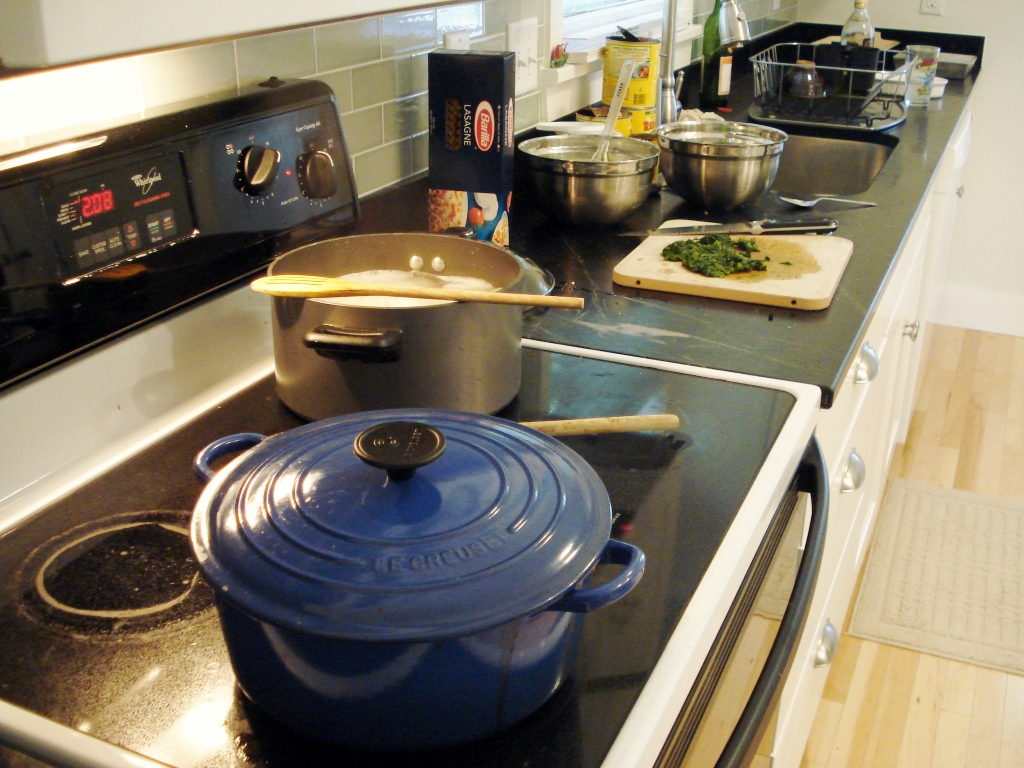
Giant mess
Assembly
1 lb lasagna noodles
Olive oil
1 lb mozzarella cheese (fresh or shredded, either is fine.)
Cook the noodles according to the package – I’d throw several tablespoons of salt into four or five quarts of water and boil them in that. Pull them out of the water and drain them, then toss them with a little olive oil to keep them from getting sticky.

Preheat the oven to 375°. (On this, Slate and I agree.) Grease your big old lasagna pan with olive oil, then coat the bottom with sauce. Put down a layer of noodles. Then spread another layer of sauce; drop half the cheese filling in little blobs all over the sauce and smooth it out into a layer as best you can. Put noodles atop this. Do sauce, cheese filling, noodles again. Top with a thin layer of sauce and then cover it up with mozzarella.

Just-a like-a that.
Bake the lasagna until it’s toasty on top and bubbly on the bottom. Watch it carefully, and if it is melted and bubbly but not toasty, you may want to run it under the broiler for a minute or three. Remove the lasagna from the oven and take the time to make a salad before slicing it and serving to acclaim.

Mangiamo!

Monday, January 17, 2011

Bienvenue Bluie!

Welcome to the family, petite chou!
This holiday season, through a combination of comparison shopping, lurking in cooking stores, and fortuitous receipt of gift cards, I made a longtime dream come true. I bought a 4.5 quart cobalt blue French oven from Le Creuset.

There was my new baby, all round and smooth and perfectly blue! What would I do to welcome her to the family?

I knew: I’d make cassoulet from Mastering the Art of French Cooking. No, I had never made it before. But it’s one of my favorite kinds of food: making it once is like making four other different things! Twice!! And I would get to put Bluie through her paces.

First there was shopping. I did not want to use lamb, as Mastering suggests. (My better half does not want to eat anything cute and fluffy.) Goose, duck, and partridge were uncomfortably expensive—especially right after the excesses of Sparklemas. I decided to use pork.


Polish sausage and ham hock
from Tollefson. Pork rind from
Finer Meats.
Even on a regular day, this dish calls for four different kinds of pork: roast, side or salt pork, sausage, and pork rind. I thought a nice, flavorful ham hock would be the perfect economical stand-in for rich duck or goose confit. I went to the Minneapolis Farmers Market to see Dan Tollefson, my favorite pork farmer in the world. He set me up with everything but rind. After calling all over the city, I found it at Finer Meat Company just a few blocks from my house. Who knew that this store was there? And why didn’t they tell me?! Finer Meat has a beautiful array of fresh, smoked, and salted meats. They have a shelf of meat-related groceries. (They have butcher hats on, for crying out loud!) They sold me a half-pound of lovely pork rind for a buck.

I’m not going to recite the recipe, since it is tiresome in its length and also it’s not mine. My Google fu turned up this, which will get you there. Instead of goose, I used a pork roast per Mastering’s original instruction. Instead of lamb, I used a ham hock per my imagination.

First, make a roast. Brown a pork loin and then some onions and carrots. Throw in a bouquet garni, then cover and pop in a 325 degree oven for an hour and a half.


(Just so you know, I used some bean cooking water to wash this tasty brown stuff back into the pot.)


Pork rind: weirdly elegant?
While all that jazz is going down in the oven, time to start the beans. Child specifies the quick-soak method. While the beans soak in their hot bath, freshen the pork rind in two changes of boiling water. Then cut it into quarter-inch dice and simmer it for a half hour. You’re essentially making gelatin here: the softened pork rind will melt to nothing but collagen. It will add velvety body to the finished dish.


All the stuff in the picture to the right, here, has got to get crammed into the same pot to simmer for an hour and a half. Julia wasn’t kidding about an 8-quart pot. I didn’t listen. I’m using the gray pot because Bluie was in the oven during this part.


C'est magnifique! Also I don't
speak French.
While the beans are cooking, or maybe the next day, you can make another meat dish. Mastering has many suggestions, including lamb braised with browned bones that add flavor. I had some meaty pork bones left over from Sparklemas dinner. I browned those in Bluie, then browned two chopped onions and two diced carrots. The bones went back in the pot along with a ham hock, a bottle of Sauvignon Blanc, a can of tomato paste, two bay leaves, four cloves of mashed garlic, and a half teaspoon of thyme. I braised that in the oven for an hour and a half.


Finally, everything is cooked and it smells like a French chophouse in here. Time to assemble...


...and top with crumbs and butter.


After baking it looks... um, it looks rather brown.


But it tastes like the heavenly congress of pork and beans. Which it is!


And though I scrubbed her with an enamel-safe pad and plenty of soap, Bluie has a few brown battle scars on the bottom of her. Ah, c’est la vie, little one. You work hard in this family of pots and pans. You get a mark here, a ding there. But you are no less beloved for it; no less beautiful to me.