Showing posts with label onions. Show all posts

Monday, September 3, 2012

Turn My Head Around


“That is so cool! Show me again, Ben!” I hollered.

The man in the white Open Arms of Minnesota chef’s jacket smiled and took another head of cauliflower. He placed it, stem down, on the cutting board and sliced it in half. He turned one of the sections to face him, then made two cuts across the core. He picked up the cauliflower half and, in the same motion, broke the top and bottom sections apart. The leaves and core came off cleanly in one whole piece, leaving the florets.


“Well that’s sure got my attention,” I remarked admiringly. “I’ve always just cut stuff off the core by attacking the cauliflower stem side up and wedging my knife in. I never thought to turn it over.”

Every so often, even after years of cutting up vegetables, there’s something new to learn as a volunteer at Open Arms. And because we’re always cooking for a crowd—hundreds of meals a day—I had half a case of cauliflower in front of me for practice.

My newfound skill reminded me of a mixed pickle recipe I haven’t made in awhile. All the critical ingredients are crossing paths in the farmers’ markets, so now is a great time to make them.

Mixed Cauliflower Pickles
Makes 4 pt
The great thing about hot-pack pickles—that is, the kind you simmer before packing into jars—is that you don’t have to seal them if you don’t want to (or don’t know how). You can put them in any nonreactive container and pop them in the fridge.

A 2-lb head of cauliflower, cut into florets
2 big green peppers or 3-4 banana peppers, cored and cut into 1" squares
5 big carrots, peeled and cut into 1" chunks
5 stalks of celery, sliced ½" thick
1 large onion, sliced ⅛" thick
3 T canning salt
2 qt cider vinegar
2 c sugar
1 T yellow mustard seeds
1 t powdered turmeric

Toss the vegetables with the salt in a glass, ceramic, or stoneware container and let them sit out overnight.

The next day, drain the vegetables, cover them with water, and drain them again. Put them in a pot with the rest of the ingredients. Bring to a boil, then simmer ten minutes. Seal in pint jars with two-piece caps in a boiling-water canner; about ten minutes ought to do the trick.

Or, if you don’t want to do that, just take them off the heat, pack the solids into nonreactive containers, and ladle juice over to cover.

Easy, fun, and attention-grabbing!

Sunday, June 10, 2012

Lasagna Is Not an Appropriate Summer Dish


“Why are you making lasagna when it’s 9 billion degrees outside?” tweeted @amycrea, a tweeple who has become an IRL friend. (And who ought to know better than to ask.)

Why? Why?? What do you mean, “why?”
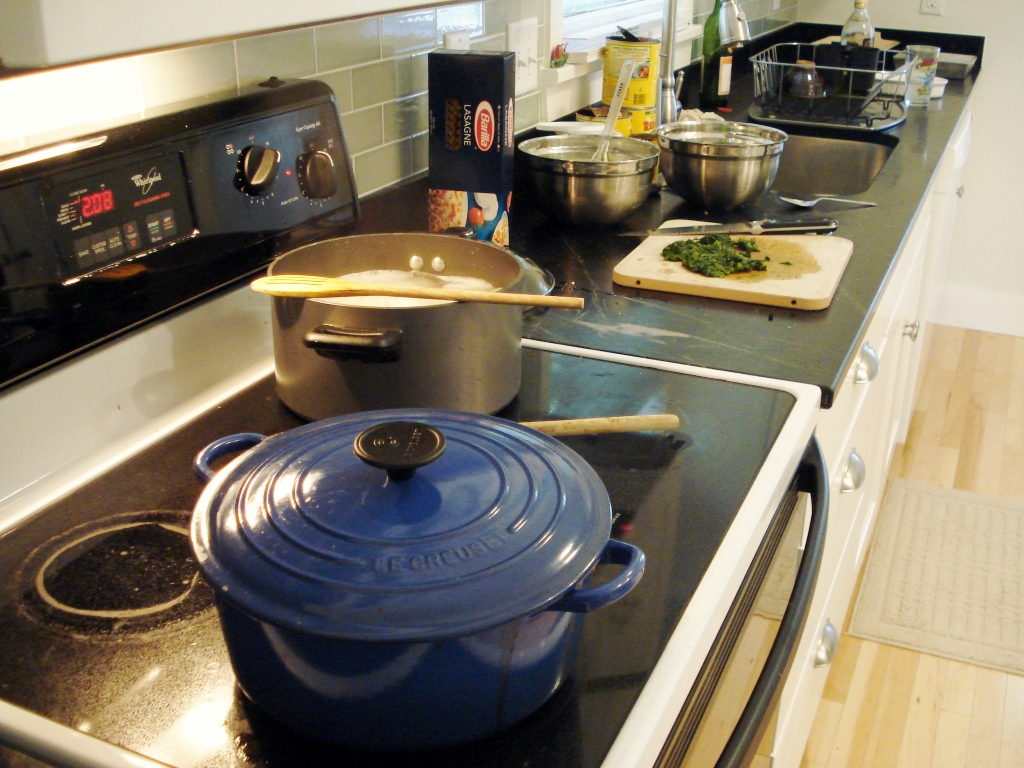
  • I got a new blue Le Creuset earthenware pan for my birthday! Yay! Now I’m feeling adventurous!
  • I read an article about lasagna on Slate.com in a series called “You’re Doing It Wrong.” Nothing pisses me off more than being told by Internet hipsters that I’m doing something wrong. Plus, for someone who’s telling everyone they’re doing it wrong, the author holds a rather shallow understanding of what makes a good tomato sauce. Rrr! Now I’m feeling vindictive!
  • I have promised to bring dinner to my friends Deb and Sean, who are new parents. Now I’m feeling all protective.
So add it up: if you had the whole clear blue sky before you; and THEN you had to one-up someone; AND you could feed it to your loved ones—well, doesn’t that equal lasagna? Weather be damned!

Ridiculous, Ridiculous, Ridiculous
I followed Slate’s suggestion and made mushroom lasagna, except they don’t know what they’re doing so I fixed their recipe. They ARE right, however, about ingredients: get the best stuff you can find. There are three parts to the recipe: sauce, cheese filling, and assembly.

The ingredients PLUS a beadwork snail
Sauce
Olive oil
1 onion, chopped
½ head garlic, chopped
½ to 1 lb mushrooms, chopped
1-2 sage leaves 1 t dried rosemary
3 cans crushed tomatoes
1 can tomato paste
1 cup wine
1 big sprig basil, leaves plucked and torn
Salt and pepper to taste

I overfilled ol' Bluie again. Relax, though, it's a double recipe
 Heat the olive oil in a heavy pan. Sauté the onions and garlic for a few minutes until translucent. Add the mushrooms and continue sautéing until they release, then resorb, their juices. Add the sage and rosemary; then the wine, crushed tomatoes, and tomato paste. Simmer this while you do the next parts, and take your time; it would be best to simmer for an hour. Or more, even! Throw the basil in right at the end before assembly.

Cheese Filling
1 lb fresh spinach
1 lb ricotta cheese
8 oz shredded parmesan, pecorino, asiago, or other dry aged Italian cheese. Hey, shut up. No jokes about my grandma!
1 egg
A dash of freshly grated nutmeg
Salt and pepper to taste

Wash and steam the spinach. Drain it, turn it out onto a cutting board, and chop it. When it is cool enough, squeeze as much water out of it as you can.
Whisk the egg in a medium bowl. Dump in everything else and blend.
Giant mess
Assembly
1 lb lasagna noodles
Olive oil
1 lb mozzarella cheese (fresh or shredded, either is fine.)
Cook the noodles according to the package – I’d throw several tablespoons of salt into four or five quarts of water and boil them in that. Pull them out of the water and drain them, then toss them with a little olive oil to keep them from getting sticky.

Preheat the oven to 375°. (On this, Slate and I agree.) Grease your big old lasagna pan with olive oil, then coat the bottom with sauce. Put down a layer of noodles. Then spread another layer of sauce; drop half the cheese filling in little blobs all over the sauce and smooth it out into a layer as best you can. Put noodles atop this. Do sauce, cheese filling, noodles again. Top with a thin layer of sauce and then cover it up with mozzarella.

Just-a like-a that.
Bake the lasagna until it’s toasty on top and bubbly on the bottom. Watch it carefully, and if it is melted and bubbly but not toasty, you may want to run it under the broiler for a minute or three. Remove the lasagna from the oven and take the time to make a salad before slicing it and serving to acclaim.

Mangiamo!

Saturday, September 17, 2011

This Doesn't Suck


“WHAT?!” I squawked.

“I don’t like it,” Beth repeated.

“But you like corn, and you like cream, and I replaced the lima beans with edamame, and you like that,” I insisted.

“Yes. I like those things, but I hate the succotash taste.” She patted my cheek. “More for you.”

More for me indeed.

Amy’s Take on Tash
The prime elements of succotash are corn and beans. They’re in season now, at the juxtaposition of summer and fall. You can tart it up with other things, too. This serves 4-6 people as a light main dish or a generous side.

4 ears fresh corn (will render 4 cups kernels)
1 pound edamame (will render 2 cups of shelled beans)
1 large red bell pepper, seeded and diced
1 medium onion, diced
1 medium zucchini, quartered lengthwise and sliced
1 T butter
1 c heavy cream
1 t dried thyme or 1 T fresh thyme leaves
Salt and freshly ground black pepper to taste

Throw the edamame, in its shell, in a pot with a half inch of boiling water. Cover and steam them about 5 minutes, then drain and pop them out of their shells.

Cut the kernels off the cobs of corn. Use a sharp knife, stand the ear on end, and cut close to the cob, taking care not to cut into it. Cut off 2 or 3 rows at a time. Then turn the knife over and scrape the dull edge along the cob to extract the “cream.”

Melt the butter in a heavy-bottomed saucepan. Sauté the onion, pepper, and zucchini until the onion are translucent. Remove from the pot and set aside.

Pour the cream in the pot and boil gently until reduced by half. Throw all the other ingredients in there and bring them back up to a bubble. Turn the heat down, cover the pot, and simmer for 5 or 10 minutes—until the corn is cooked and the edamame are tender. Correct the seasoning and serve to acclaim!

Sunday, August 28, 2011

Green Salsa for Lazy People


I have a rule of thumb for salsa: a good recipe has five things in it. Why? Because then I can remember it by counting it off on my hand. I am too lazy to go through life looking up the recipe for something that I should know how to make off the top of my head.

Circular logic aside, I have a convergence of vegetables today: tomatillos, jalapeños, onion, cilantro, and garlic. See? Five things.

Tomatillos usually get cooked, so I will throw them in a pan with water. I will throw in the jalapeños, too. If I were feeling really lazy, I wouldn’t seed them first. I’m going to do it, though, because the people who will eat this with me don’t like too much heat. I may be lazy, but I’m not MEAN and lazy.

Meanwhile I chop up some onion and some cilantro and a clove or two of garlic. How much? Some. Who cares. I’d measure, but I’m too lazy. How fine to chop things? Meh. La-a-a-zy.

Here’s what makes it super lazy: all the things are just going in the blender. I will push a button and then it will be salsa. How much lazier can I get?!

Tomatillo Salsa
A handful of tomatillos, husks removed, rinsed
One or two jalapeño peppers, seeded or not
A clove or two of garlic, minced
A few tablespoons of onion or scallion, chopped
A handful of cilantro, chopped roughly

Put the tomatillos and jalapeños in a pan with water just to cover. Bring to a simmer and cook until the tomatillos turn a dull green and get heated through, about 5-10 minutes. Drain.

Meanwhile, wash and cut up the other three things.


Throw everything in a blender and pulse a few times until everything is roughly blended. You should have chunks and lumps and few worries.

If you need to add a little salt to taste, I won’t tell and I won’t count it as one of the five ingredients.

Sunday, August 14, 2011

Justify My Fennel


Mom called me a few weeks ago to chat. We got to complaining about our fennel. “Mine isn’t making any bulbs,” I said.

“Mine isn’t either,” she replied. Earlier this spring, we had split a six-pack of bronze fennel seedlings. We had checked the tag carefully to make sure it would make bulbs. We’d been assured it would. It hasn’t.

“Guess we got sold a bill of goods,” I grumped.

The fennel has been making really pretty leaves, though. It looks wispy and airy in the garden. I read in one of my garden magazines that fennel flowers are good for bees, butterflies, hoverflies, and other amusing pollinators. So when my ne’er-do-well vegetables started to bloom, I didn’t stand in their way.

I thought bronze fennel ought to earn its keep at least once this summer, so I snipped some leaves into a cucumber salad. Not only does the leaf look great against the pale green of the cucumber, but the flavor complements the sweet-sour of apple cider vinegar and a pinch of sugar in the dressing.

I, though, am not the one who has most been enjoying the fennel this summer. I went to the garden today to admire my fennel, and I found something that makes up for any disappointment I might have felt before. There was a big fat black swallowtail caterpillar munching down one of my plants.


Hooray! You keep at it, sweetie. When you finish that one, there are three more just like it.

Cucumber Salad
Better get some before Swallowtail finishes it all off...

4 cucumbers
1 small sweet onion
2 t salt
2 t sugar
¼ c apple cider vinegar
3 T olive oil
A few grinds of black pepper
2-3 T snipped fennel leaves

Slice the cucumbers and onions. Toss them with the salt and set aside for half an hour. Briefly rinse them, then drain well.

Meanwhile, whisk the rest of the ingredients together. Toss them with the cucumbers and onions. Done!

Saturday, January 22, 2011

A Day to Celebrate Pie


The American Pie Council® has declared January 23 National Pie Day! The APC’s web site proclaims a day “dedicated to the celebration of pie.”

According to the APC’s notes about pie history, “Pie has been around since the ancient Egyptians. The first pies were made by early Romans who may have learned about it through the Greeks.” So not only is pie A) delicious; but it B) has the power to transcend space/time and C) is not subject to the laws of cause and effect.

Hooray for Pie!

Zwiebelpastete
I brought this dish, based on a recipe from Marianna Olszewska Heberle’s German Cooking, to a Pie Day party. The original recipe called for bacon, but I (rightly) guessed there’d be vegetarians and left it out. Instead, I used repeated simmering to draw out and deepen the flavor. When people asked how to say this word, I explained it is pronounced “onion pie.”


½ cup butter
1 c flour
1 pinch sugar
1 pinch flour
2-3 T milk
1 T olive oil
3 large sweet onions, sliced
1 c vegetable broth
¼ c vodka
½ c sour cream
1 egg plus 1 egg white, lightly beaten
1 T chopped fresh chives
Salt and pepper to taste
1 egg yolk, beaten with ½ t water
¼ t caraway seeds
Paprika

Mix flour, sugar and salt; cut in butter until mixture is like coarse meal. Sprinkle on the milk, mix with a fork, and form the dough into a ball. Roll out and line a greased 10" or 11" pie pan with the dough. Crimp or flute the edge and trim off the extra. If you have time, wrap loosely and let the crust rest from an hour up to overnight. This will keep fancy edges from puffing out of shape in the oven.

Heat the oven to 350°. Prick the crust all over with a fork, weight it, and bake until browned, perhaps 20 minutes. Remove the weights and set the crust aside.

Meanwhile, heat the oil in a big sauté pan. Cook the onions gently until they begin to soften. Splash in half the stock and continue stirring until the liquid evaporates. Splash in the rest of the stock and repeat. Splash in the vodka and cook the onions down one more time. Set them aside.

Turn the oven up to 375°. Separate one of the eggs and set the yolk aside. Beat the white and the other egg, then mix with the chives, sour cream, and salt/pepper to taste. Mix this into the onions. Spread the onion mixture evenly in the bottom of the pie crust.

Beat the leftover yolk with the half teaspoon of water and brush all over the top of the pie. Sprinkle on the caraway seeds and dust the top with paprika. Bake until the pie is set and the top begins to brown, about 20 minutes.

Let cool slightly and serve warm.

Happy Pie Day!