Sunday, August 12, 2012
You Know What I Like?
It ain’t no big thing.
Late for my job and the traffic was bad, had to borrow ten bucks from my old man, uh huh. It ain’t no big thing.
But I know what you like:
With apologies to Lita Ford.
Mojitos by the pitcher
3 limes
1 handful mint leaves
1½ c simple syrup (make by shaking 1 c sugar and 1½ c water in a jar until clear)
2 trays ice cubes
1½ c rum—I like Flor de Caña and I like it dark
2 c fizzy water
Throw the mint leaves in the bottom of a pitcher. Quarter the limes and squeeze each quarter into the pitcher. Take a wooden spoon and mess things up in there; smash up those mint leaves a little. (This is the famous muddle.) Add the syrup, fill up the pitcher with ice, then pour in the rum and fizzy water. Stir and serve.
Drink while wondering, “What is she doing to that guitar? And why?? And what is that beadwork snail doing on the cutting board? What the hell exactly is this post about, anyway?”
Sunday, June 10, 2012
Lasagna Is Not an Appropriate Summer Dish
“Why are you making lasagna when it’s 9 billion degrees outside?” tweeted @amycrea, a tweeple who has become an IRL friend. (And who ought to know better than to ask.)
Why? Why?? What do you mean, “why?”
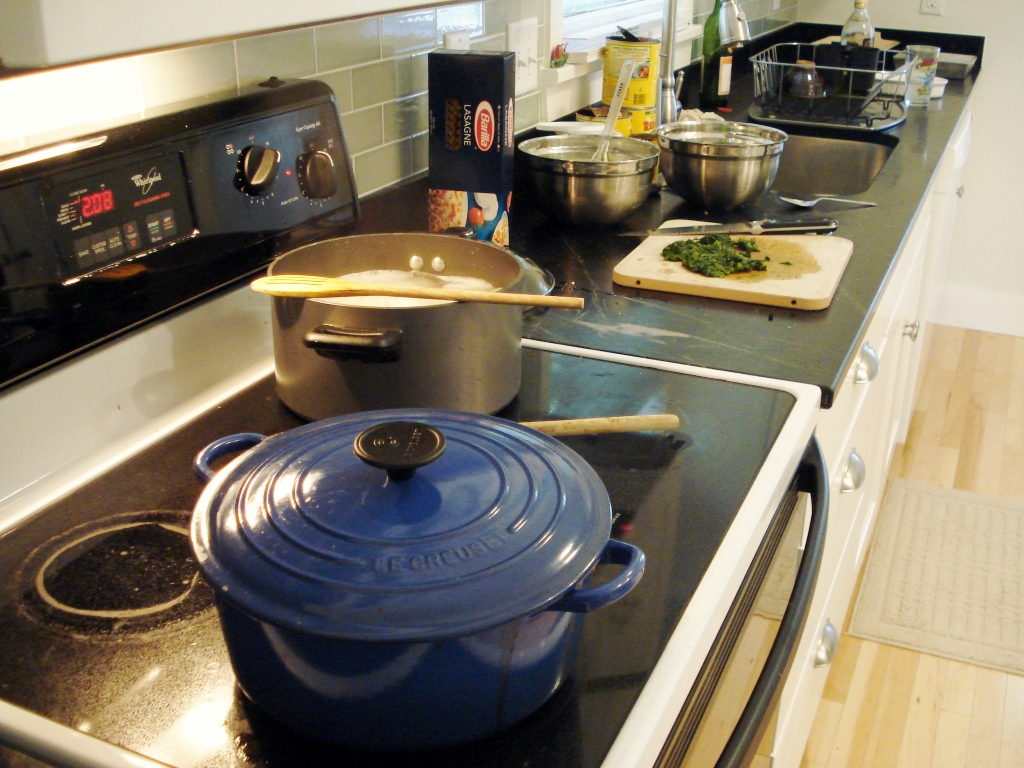
- I got a new blue Le Creuset earthenware pan for my birthday! Yay! Now I’m feeling adventurous!
- I read an article about lasagna on Slate.com in a series called “You’re Doing It Wrong.” Nothing pisses me off more than being told by Internet hipsters that I’m doing something wrong. Plus, for someone who’s telling everyone they’re doing it wrong, the author holds a rather shallow understanding of what makes a good tomato sauce. Rrr! Now I’m feeling vindictive!
- I have promised to bring dinner to my friends Deb and Sean, who are new parents. Now I’m feeling all protective.
Ridiculous, Ridiculous, Ridiculous
I followed Slate’s suggestion and made mushroom lasagna, except they don’t know what they’re doing so I fixed their recipe. They ARE right, however, about ingredients: get the best stuff you can find. There are three parts to the recipe: sauce, cheese filling, and assembly.
| The ingredients PLUS a beadwork snail |
1 onion, chopped
½ head garlic, chopped
½ to 1 lb mushrooms, chopped
1-2 sage leaves 1 t dried rosemary
3 cans crushed tomatoes
1 can tomato paste
1 cup wine
1 big sprig basil, leaves plucked and torn
Salt and pepper to taste
| I overfilled ol' Bluie again. Relax, though, it's a double recipe |
Cheese Filling
1 lb fresh spinach
1 lb ricotta cheese
8 oz shredded parmesan, pecorino, asiago, or other dry aged Italian cheese. Hey, shut up. No jokes about my grandma!
1 egg
A dash of freshly grated nutmeg
Salt and pepper to taste
Wash and steam the spinach. Drain it, turn it out onto a cutting board, and chop it. When it is cool enough, squeeze as much water out of it as you can.
Whisk the egg in a medium bowl. Dump in everything else and blend.
| Giant mess |
1 lb lasagna noodles
Olive oil
1 lb mozzarella cheese (fresh or shredded, either is fine.)
Cook the noodles according to the package – I’d throw several tablespoons of salt into four or five quarts of water and boil them in that. Pull them out of the water and drain them, then toss them with a little olive oil to keep them from getting sticky.
Preheat the oven to 375°. (On this, Slate and I agree.) Grease your big old lasagna pan with olive oil, then coat the bottom with sauce. Put down a layer of noodles. Then spread another layer of sauce; drop half the cheese filling in little blobs all over the sauce and smooth it out into a layer as best you can. Put noodles atop this. Do sauce, cheese filling, noodles again. Top with a thin layer of sauce and then cover it up with mozzarella.
| Just-a like-a that. |
Sunday, March 4, 2012
Just sayin'
Beet Reuben: grilled Swiss cheese on pumpernickel with sauerkraut, hard-boiled egg, roasted beet, and Thousand Island dressing.
Thanks to Deb and Sean for the idea and Jenn for the inspiration!
Wednesday, September 7, 2011
Just sayin'
Sunday, May 22, 2011
Nettles called...
OK, you have a point. But if you just handle them right, nettles are cool. They can hang out in all kinds of snacks, like pasta and soup and frittata and stuff. Sometimes when you meet a vegetable and you can’t seem to get along, you should just do what you like to do until you get to know each other better, K?
Like, if you have 15 minutes, some cheese, and a couple of tortillas, maybe you guys could make quesadillas together. Then you’ll be just chillin’ with a beer, you and your new friend Nettles.
Nettle Quesadillas
1 bunch nettles (mine came from Harmony Valley)
1 cup shredded cheese
8 corn tortillas
2 T oil
Salt to taste
A dollop of salsa if you want
Wear gloves to pick the nettle leaves off the stems. Wash them well and spin them dry. There should be about 2 tightly packed cups of leaves.
Heat a tablespoon of oil in a heavy frying pan. Toss the nettles in the hot oil until they reduce in volume and cook through; you may need to throw a splash of water in the pan to keep things from sticking. Remove the cooked nettles to a plate or bowl and season to taste.
Saturday, January 1, 2011
Kabocha is Squashspeak for “I Love You”
New Year’s Eve used to be my third most hated holiday.* But Beth has changed all that. New Year’s Eve is our anniversary!
I love Beth more than I can explain to you. I love the complement between her formidable intellect and her capacity for abject silliness. We laugh together every single day.
I love her giant heart: I have never met anyone who works as hard as Beth does to understand herself, to take responsibility for her actions, to extend a hand of compassion to others.
I love the fact that, though she’s a little tiny thing, she can eat an entire New York strip in a sitting. My baby can put the steak away, aww yeah.
So of course I made a steak for her on our special day. And there had to be something good to go with it. Bread? Pah! Baked potato? Fwuh! My girl loves squash. Imma make her some kabocha gratine.
Oh, kabocha. It is the most fine-grained, sweet, and creamy vegetable you could ever hope to meet. Its Crayola-colored rind peels away to reveal carrot-orange flesh streaked with green, yellow, and red. Can you resist sneaking a raw bite? It is crisp and sugary as a carrot, too.
Layer the slices in a baking dish and cover them with velvety cheese sauce, and you have decadence incarnate. The squash bakes to melting tenderness in a surprisingly short amount of time. The gratine is unctuous and rich, bathing the senses in deep flavors and smooth texture. Want to render your lover speechless with pleasure? Just slip a few spoonfuls of this onto her plate.
*After Christmas and Valentine’s Day. We fixed Christmas, but we still hate Valentine’s Day.
Kabocha Gratine with Four Cheeses
The remains of our Sparklemas cheese plate went into the sauce. More fun than the traditional Swiss!
A kabocha squash, peeled, seeded, and sliced
¼ cup (half a stick) butter
2 T flour
1 c milk or cream
1 c grated/shredded/mangled cheese, divided. I used scraps of chevre, Manchego, Parmesan; and mostly mozzarella. Swiss would have been better than mozzarella, but that’s what I had.
A dash of fresh-ground nutmeg
Salt and pepper to taste
Preheat the oven to 350°. Butter a glass or ceramic baking dish. Arrange the squash slices in one layer, slightly overlapping them so the bottom of the pan is covered.
Melt the butter in a saucepan and sift in the flour. Whisk until smooth. Pour in the milk or cream and cook, whisking constantly, until thick—right before the liquid comes to the boil. Take the pan off the heat and stir in ¾ cup of cheese. The sauce should be thick and the cheese completely melted. Add the nutmeg, salt, and pepper.
Pour the sauce over the squash, taking care to cover it up well. Put the pan in the oven and bake until bubbly and browned, about 30 minutes. The squash should be tender. Sprinkle the remaining cheese on top and put back in the oven until melty and toasty, another 5 to 10 minutes.
Serve to acclaim.
Sunday, October 10, 2010
Cardoons: Once is Enough
Note: There is an F-bomb in this post. You were warned.
Cardoons! Limited supply! Only take some if you can experiment with them and report back! So said the CSA announcement this week. Cardoons! I’d heard of them and been hoping for years to try them.
According to a British gardening book that I have somewhere in my house but can no longer find, cardoons are a tall and dramatic-looking member of the thistle family, a relative of artichokes, and a back-of-the-garden oddity. It used to be a common vegetable but fell out of favor sometime before the invention of the combustion engine. I’d filed the bit of information away in case I ever met this plant. And now, thanks to Harmony Valley, it was staring me in the face!
A little checking around revealed that cardoon should be de-leafed, de-thorned, and cleaned of tough strings; then boiled for fifteen minutes to an hour. It can then be made into things like crudités or salads. Joy of Cooking suggested it might taste like artichoke. I decided on a gratine. This was going to be great! I’d serve it as a surprise treat to Saturday’s dinner guests.
A high note of baking soda sang above a base taste of overcooked silage, followed by a convulsive sourness. “Oh, try this,” I gasped. “No way,” said Beth, backing away. I snatched the pieces out of the Mornay, horrified that they would taint it. And then I looked down at them, all sauce-smeared in the colander.
I never until this day met a vegetable I didn’t like. And I hate to waste anything. I screwed my courage to the sticking point and picked up one of the sauced pieces. This one was tenderer. The silky Mornay smoothed away most of the bitterness. The flavor and texture were like a mild, soft artichoke heart. I saw how this might have worked: tender inner stalks broiled up with sauce and cheese could have made a not too unattractive presentation, and they might even approach enjoyable.
But you know what? Fuck it. Cardoons are a lot of work for something only a little bit delicious. And a lot of people, my guests included, don’t even like artichoke. I dumped the whole mess straight in the trash. Sorry, cardoons.
I can see why people stopped eating these things. What I can’t see is why anyone ever decided to eat this in the first place. Maybe some feudal peasant saw her donkey munching a roadside thistle and shoved him out of the way to grab it for herself. Maybe when the choices were cardoons or nothing, cardoons were worth the fuss.
Even though I didn’t like them, I’m thankful to Harmony Valley for the opportunity to try cardoons. It had been a longtime dream, and now I can mark it up as a lifetime achievement.
Don’t try this at home
Here’s what I was going to do, had my initial bite not been so shatteringly unpleasant.
1 lb de-thorned, de-leafed, de-stringed cardoon stalks, cut in 2" pieces
2 T lemon juice
1 t salt
2 T butter
2 T flour
1½ c whole milk at room temperature
¾ c grated Swiss cheese, divided in half
Put the cardoon pieces in a pot with 8 cups of water, the lemon and salt. Boil for 15 to 20 minutes and drain.
Meanwhile, melt the butter in a saucepan and whisk in the flour. Whisk until very smooth. Add the milk, whisking constantly to avoid lumps. Whisk and whisk over medium heat until the sauce thickens. Take it off the heat and whisk in half the cheese.
Butter a glass or ceramic baking dish and pour in half the sauce. Lay the cardoon pieces in the sauce, overlapping each other slightly, and cover them with the rest of the sauce. Sprinkle with the remaining cheese. Bake in a 375° oven until the sauce is bubbly and the cheese is toasty and just browned, about 20 minutes.
Monday, September 27, 2010
¡Vivan Chiles Rellenos!
If you’re all wondering what to do with a poblano pepper, then you should go stuff it.
Har har har! No, really. And then you should batter it and fry it and serve it with a bunch of its friends.
Perhaps once a year I make chiles rellenos (say “ray-YAY-nohs.” Do not call them “reh-lennowz” unless you are still eating tor-til-ah chips.) from Diana Kennedy’s The Art of Mexican Cooking. To me, they epitomize the complexity of Mexican food. Even the most seemingly simple Mexican dish can involve multiple cooking methods and several iterations of processing. Making rellenos is like making four different dishes: roasting, peeling, and seeding the chiles; making the stuffing; making the sauce; and, finally, battering and frying the chiles. Add some side dishes to the meal, and you could be cooking all day a la Like Water for Chocolate.
Chiles Rellenos
There are four stages: the chiles, the sauce, the filling, and the frying. Finally, we eat!
The Chiles
You can stuff any pepper, but traditional cooks use the poblano. These dark green, glossy triangles are relatively mild and about the size of a fist. Start with more chiles than you’re planning to serve; I promise at least one of them will end up in shreds while you are preparing it. Roast them on a grill or under a broiler, then peel them (here’s how). Find the weakest part of the chile, slit it open lengthwise, and sweep out the seeds and veins, being careful not to tear the flesh. You may need to wipe off your fingers, or your chile, with a towel as you work. Put the cleaned chile on a plate or cookie rack. You can do this a day ahead.
The Sauce
According to Kennedy, rellenos are traditionally heated up in a sauce—essentially, a very simple tomato reduction thinned with chicken broth. I opted to skip the broth and ended up with a tangy and fresh-tasting tomato sauce. You can make this ahead of time.
2 or 3 tomatoes
2 T chopped onion
1 clove garlic, chopped
1-2 T oil
Salt to taste
Put the tomatoes, onion, and garlic in a blender and liquefy. Heat the oil in a well-seasoned skillet. Dump in the tomato mixture and fry until reduced, maybe 5 or 10 minutes. (At this point Kennedy has you add 2 ¼ cups of chicken broth and cook 5 minutes more.) Salt to taste.
The Filling
Recipes abound for the relleno, or stuffing, part of chiles rellenos. You can use seasoned meat, or maybe potatoes and chorizo. I found queso Chihuahua, the quintessential Mexican melting cheese, at the Wedge. Muenster would be the next best choice. I cut it in strips about the size of my index finger. A large poblano will take two or three of these pieces; for a tiny chile, I cut one in half.
Put cheese inside the chile, being careful not to tear it. The chile should be nice and full, but the sides of the hole should overlap a bit. If you opt to close the slit with a toothpick, be sure to warn your guests.
The Frying
Cover a plate with several layers of paper towels and put it in the oven at 200° F. Get out a big frying pan and pour in about an inch of oil. Canola is nice. Put the pan on a medium-high burner.
Now make the batter. For every four to six big chiles, get these things:
3 eggs
¼ t salt
⅓ c flour
Separate the eggs. Beat the whites until they are stiff and turning dry. Beat in the yolks, one by one, and the salt.
OK, here we go. It’s showtime. I always get very scared at this point. I’m convinced that the chiles will come apart, stick to the pan, catch on fire, splatter everywhere, or burn black. But not one of those things has ever happened. They always fry up like magic.
Hey, look at that! It worked!
Let’s eat!
If you did the broth thing, you can put the rellenos in the sauce and heat them up for five minutes or so. Otherwise, plate ‘em up! Serve each guest one big chile or two smaller ones. You can pool the sauce under them or nap it on top.
¡Buen provecho!
Sunday, July 25, 2010
Figs: Pure Romance
I ducked into the Whole Foods to buy dip, and what should appear before my eyes but a display of fresh turkey figs? They were perfectly ripe and they were on sale. When the universe is speaking to you this clearly, ignore it at your own peril.
Soft, fragrant, and curvy figs are among our most sensuous fruits. Bite or cut into one: the dusky skin just barely offers resistance, then yields to reveal white flesh and glistening pink jelly. The taste is as delicate as a caress.
“Are you going to eat that last one?”
Figs with Honeyed Goat Cheese
Sometimes you can find goat cheese with honey in the schmantzy cheese section of the grocery store. If you don’t see it, just get some chevre and put it in the blender with a couple of tablespoons of honey. Taste and add as you go until it is a nice balance of goat-tart and honey-sweet.
Fresh ripe figs
Honeyed goat cheese (see note above)at room temperature
Fresh ground black pepper
Trim any stems off the figs. Slice them in half the long way. Lay the fig halves cut side up.
Stir up the cheese so it is soft. Using two spoons, drop ½ to 1 teaspoon of cheese on the center hollow of each fig half. Arrange the figs smartly on a serving plate.
Grind a little black pepper over the figs. Bat your eyes a little as you serve them.
Thursday, May 27, 2010
Ladies Who Lunch
...wait for laughter to die down...
Here’s the deal. Two kinds of people will like this thing. First, people who genuinely like cheese logs. Second, people who like them ironically. Which one am I? I’m not going to confess, and I challenge you to guess.
Three events have converged to result in a cheese log. First, I am planning to attend a small gathering over the weekend, and snackies shall be required. Second, radishes the size of golf balls showed up in my Harmony Valley CSA box today. Third, I have been keeping the salad burnet from last week's box in a jar of water in the fridge. The plant is so pretty that nothing seemed special enough to use it in.
Well, cheese log is the thing! It is pink. It is springy and cool. It is covered with the minced leaves of a sparkly-flavored, wine-dark herb. I am so pleased with my own cleverness that I may just decide this appetizer is too special to serve.
Wait, no I won’t.
Ladies Who Lunch Cheese Log
1 package cream cheese (use full-fat or the log will not be very solid)
1 golf-ball-sized radish
2 T minced chives
A dash of salt
A handful of herb leaves, minced fine
Chop the radish and throw it in a food processor with the cream cheese. Process for several minutes until pink and smooth.
Gently stir in (do not process!) the minced chives. Salt to taste. Turn the cheese out onto a piece of waxed paper. Wrap the cheese up like a burrito and refrigerate until firm.
Unwrap the cheese. (You can cut the log in half at this point if you want it to be smaller.) Briefly smooth it out by rolling it on a counter or between your hands, and then roll it in the minced herbs until covered. Serve right away; or wrap in a clean piece of waxed paper or plastic wrap and chill until serving time.
I’ll drink to that.
Sunday, December 20, 2009
Ravioli pa' Natale
According to Mom, her nonna—my great-grandmother—spent hours and hours making ravioli for Christmas each year. They truly are a labor of love: between preparing the filling, making the pasta, rolling and assembling the ravioli, and making their sauce, it's like you've made the meal four or five times. When the food passes so many times through the hands of the cook, it cannot help but absorb what's in the heart of the cook.
And in my heart, there's joy to see the ravioli spring into the world out of nothing but flour, egg, pumpkin, and cheese. There's the warm companionship of cooking with my partner, Beth. There's a sense of connection with the women in my family, whose hands have also kneaded dough, rolled it thin, doled out filling, and set trim little pasta shapes on a floured towel to dry. And there's the anticipation of delight when, on Christmas Day, people we love will take pleasure and nourishment from the food we're making.
Ravioli di Zucca pa' Natale
That is to say, pumpkin ravioli for Christmas. This is my recipe, not Nonna's, but I hope she'd be proud. You can make the filling ahead of time and freeze it. You can also freeze the ravioli.
This recipe will make perhaps 80 or so ravioli. For a side dish, plan on 6 per person. For a main dish, plan on 9 to 12 per person.
The filling:
A pumpkin, 3-4 lb.
½ lb. grated Parmesan
Salt and black pepper to taste
The pasta:
5 c semolina flour (any other kind will work)
5 eggs
A tablespoon or two of olive oil
The sauce:
For every 6 ravioli you plan to serve,
1 T butter
2-3 sage leaves, fresh or dried
1-2 baby spinach leaves
1 T shaved Parmesan cheese
Ground black pepper
Peel the pumpkin, cut the flesh into small pieces, and mash it. Mix it with the Parmesan and seasonings to taste.
On a wooden cutting board or directly on your work surface, make a mountain of the flour. Make a volcano crater in it with your fist. Crack the eggs into the crater and add a splash of olive oil.
Set a pot of salted water on the stove to boil. Heat the butter in a skillet or saucepan. Gently sauté the sage leaves until they are crispy; break them up in the butter a little. Sliver the spinach leaves.
Cook the ravioli. If they are fresh, this will take less than five minutes. If they are frozen, just drop them right in the boiling water without thawing.
Drain them well and arrange them on a plate. Drizzle them with the sage butter, sprinkle with shaved parmesan, and toss on a smattering of the spinach slivers. Finish with a grind or three of fresh black pepper.
Buon Natale, mios amicos.
Sunday, August 23, 2009
Fish Tacos with All the Fixings
This post originally published 8.23.2009. Photos added 9.20.2009.
[REDACTED: Friend, I’m sorry. I just came home from a weekend out of town, and so I did not cook and photograph this dish for you like usual. But I plan to cook it next Friday—and then you could cook it, too, and it would be like we were having dinner together. Cheers!]
Two or three summers ago, I made it my mission to create the perfect fish taco. After extensive research at restaurants, fish shacks, and taco stands around the Twin Cities, I settled on a few (highly opinionated) fish taco axioms:
- Grilled fish, not breaded and fried. Breading hides the fish; it’s for poseurs. Also, the entire arrangement will be wrapped in a tortilla, which is technically a kind of bread.
- Corn tortillas only. No wheat. Wheat tortillas are the wrong size, texture, and flavor. Plus they are morally bankrupt! Tortillas are made of corn! ¿Entiende?
- There should be vegetables, but you should never put iceberg lettuce in a fish taco. In fact, you should never put iceberg lettuce anywhere. Certainly not in your mouth.
- There should be some sauce. A finely chopped pico de gallo is good. There’s a special fish taco sauce, too. At the very least, there should be a lime to squeeze on the taco.
- Finally, it would be a really nice touch to serve some black beans and queso fresco to go along with the tacos.
I used these rules to develop my own recipe for fish tacos with all the fixings. This would be a good thing to serve to friends for a last summer hurrah on the patio. Maybe throw in some margaritas or Negra Modelo and a nice fruit sorbet for dessert.
Fish Tacos with All the Fixings
This will serve four people. There is a lot going on in here, and this is the order in which I think you should fix things.
Prep List:
- Pickled onions
- Seasoned fish
- The sauce
- The fixings
- Grill the fish
- Heat the tortillas
- Assemble the tacos
The pickled onions:
This excellent pickle comes from Diana Kennedy’s The Art of Mexican Cooking.
1 lb red onions, trimmed, peeled, sliced thin
½ c fresh lime juice
1 ½ t sea salt
Put everything in a glass bowl, mix, and allow to macerate for 2 hours. Maybe stir the onions halfway through and press them down into the juice. They will make more liquid as they pickle. They’ll keep, refrigerated, for weeks. (But when you find out how good they are on a sandwich, they will never live as long as a week.)
Back to prep list
The seasoned fish:
2 t thyme
1 t black pepper
¼ t cumin
½ t cayenne pepper (more if you are a chile-head)
½ t salt
1 lb catfish fillets
Mix or grind the seasonings together. Rub them into the fish fillets. Stack the fillets and set aside 1 hour or more.
Back to prep list
The sauce:
Besides the bare minimum of squeezing a lime over the fish, it's fun to dress up your tacos with sauce. You can use a fresh homemade pico de gallo. You can use any kind of good quality bottled salsa. I also serve this one.
8 oz sour cream
Juice of 1 lime
Bufalo chipotle sauce or any hot chile sauce
Mix them all together, adding chile sauce to taste and lime juice until the sauce is like a thin mustard. I use a funnel to pour the sauce into a squeeze bottle.
Back to prep list
The fixings:
- Half a head of red or green cabbage, cut as fine as you can. (I’d use a knife. Food processors tend to mush up the cabbage.)
- One or two jalapeños, cored, seeded, and sliced into thin rings.
- A bunch of cilantro, picked off the stem if you are patient or chopped if you are not. It is acceptable to have some soft stems in your cilantro.
- The pickled onions.
- The sauce(s).
- Tortillas: They must be the small corn kind. You will need four per person, two for each taco.
- Black beans: These go next to the taco, not on it. If you don’t want to make your own, then Bearitos has a nice fat-free refried black bean.
- Queso fresco: Crumble it and put it on the hot beans. Mmmm.
Back to prep list
Grill the fish:
Grill it two or three minutes on a side, then test it with a knife. If it is almost as cooked as you’d like, take it off the heat. The fish will continue to cook a little on the serving plate.
Back to prep list
Heat the tortillas:
You need 16 small corn tortillas to make 8 tacos for 4 people.
I have one of those hateful glass-top electric stoves. Its only saving grace is that I can do this right on the stovetop. You may prefer to heat up a dry skillet.
Put the first tortilla on the hot, dry surface for about three seconds. Flip it over (use your fingers if you are clever or a spatula if you are cautious) and put the second tortilla on top, then wait three seconds. Flip the stack over, then add the third tortilla and wait three seconds. The tortillas should be getting some dark spots on them from this treatment. Even if a bit of charred tortilla gunk accumulates on the hot surface, you’re still good.
Continue flipping the stack and adding a tortilla until all the tortillas are on the stack. Do the final flip, wait the final three seconds, and then transfer to a warm plate and cover with a clean dish towel.
Back to prep list
Assemble the tacos:
For each taco, lay two tortillas on the plate so they overlap. Take a fork to the fish fillets and flake/break off about two ounces of fish per taco; put this on the tortillas. Squeeze on some lime. Dress with fixings as desired, being careful not to overstuff. Top with a wee bit of sauce(s). Put a nice spoonful of black beans on the plate and put some crumbled queso fresco on top of them.
To eat the taco, fold the tortillas over the bottom and then fold the sides over to make a packet. It’s better to make a lot of little tacos than one giant taco.
¡Buen provecho!