Showing posts with label dill. Show all posts
Monday, January 9, 2012
Just Sayin'
Scrambled eggs, gravlax with mustard dill sauce (thanks to my colleague Sue and her Danish-born loved ones), and a big pile of spring mix.
Labels:
dill,
eggs,
just sayin',
salad,
salmon
Tuesday, May 31, 2011
Mustard Jar Redemption
I’m really sorry I didn’t take the picture earlier. This is all that was left by the time I got back to the kitchen from grilling the brats. The other diners were merciless; they took no prisoners.
At least they didn’t take the last spoonful of potato salad, too. Even if they had, I would be too busy being proud of my recipe to get upset. I like this one for two reasons:
- It is fresh, simple, and immediate. There are only a handful of ingredients, but the vegetables can be locally grown and soon they’ll all be in season together.
- The dressing is a great way to finish off a jar of mustard.
Well this salad dressing will take care of it for you! There’s probably just the right amount of mustard left in the jar. Take off the lid, put in the rest of the dressing ingredients, and shake. You will get a delicious salad dressing. You will clean up the container so it is fit to go in with the recycling. And you will have used up the last of that mustard. Aaah, closure!
Potato Salad with Dijon Dressing
Serves 6 to 8.
1 ½ lb potatoes (new red potatoes are great), scrubbed and cut in chunks
½ lb asparagus or green beans, snapped into 1” pieces
2 T Dijon mustard
2 T red wine vinegar
2 T lemon juice
1/3 c olive oil
3 T dill leaves, coarsely chopped
1 T capers
Boil the potatoes until just tender, about 20-25 minutes. In the last few minutes of cooking, throw the asparagus or green beans into the pot.
Drain the vegetables and plunge them into ice water to stop the cooking. Drain well. Chill.
Shake the mustard, vinegar, lemon juice, and oil until combined.
Close to serving time, toss the vegetables with the dill, the capers, and the dressing. If you leave the salad sitting in its dressing, the potatoes will absorb much of the liquid. Who knows; maybe you like that sort of thing.
Wednesday, August 25, 2010
These Beans Are Greek to Me
How Greek is this dish? Heck if I know. I had it on vacation two weeks ago in a restaurant called Ethos. The hostess had a large swooping mane of platinum-colored hair and a flowy tiger-striped blouse. She kept the waiting list in her head and seemingly knew what every single person in the restaurant, whether staff or customer, was doing and what they needed next. She was born to be a maîtresse d’hôtel.
That staff of hers is great, too. Our server knew not only every dish, but every one of a dozen fish on the menu by their Greek and English names. Some of them were catch of the day. She knew all those fish well enough to have a favorite.
She brought a green bean dish with a sharpish-tasting tomato sauce. There was a subtly sweet, woodsy undertone to it, though, that I could not place. Finally I found and identified the culprit: whole allspice. Who would expect to find that at a Greek restaurant?
Well, when your mouth is full of something good, you don’t need to know what’s Greek. You just need to enjoy.
Ethos Green Beans
The allspice berries at Ethos were nearly tasteless, their deliciousness having escaped into the sauce via stewing. My guess is that the chef starts a batch of the sauce in the afternoon and then keeps it on the back burner all night. When the kitchen receives an order for this dish, maybe Chef scoops up a dollop of sauce, tosses in the beans and dill, and then simmers them tender while he or she makes the rest of the meal.
2 T olive oil
1 small onion, chopped
1 clove garlic, minced
2 cups chopped tomatoes (I used a pint of cherry tomatoes plus one small beefsteak tomato)
½ cup white wine
3 allspice berries
A sprig of oregano
1 lb green beans
2-3 T chopped fresh dill
Salt and pepper
Heat the olive oil in a wide-bottomed, deep pan. Sauté the garlic and onion until translucent. Toss in the chopped tomatoes and fry them a bit until the pan starts to dry out. Add the wine, allspice, and oregano. Turn down the heat, cover the pan, and simmer for fifteen or twenty minutes. Check the pan often and throw in some water if things are getting too dry. It would be best if the dish could simmer on low heat for a long time, but if there isn’t time for that, cook it harder. The idea is for the tomatoes to break down into a thin sauce.
Throw in the green beans and the dill, stir, and cover the pan again. Let the pot stew, stirring occasionally, until the beans are quite tender, perhaps ten minutes or more. They will not be the bright green of steamed beans; they will start to turn olive-colored.
For the last minute or two, take the cover off the pan and check the thickness of the sauce. It should be thin but with some body, like gravy. You may need to let some extra water steam off.
Season to taste. Yum!
Sunday, August 30, 2009
Pickling: the Art and the Science
For the twelfth year running, I opened canning season on the last Saturday in August. My kitchen filled with steam, vinegar fumes, and business as a small group gathered to enact the mechanical and chemical processes--and the acrobatics of slicing and seasoning--that transform fresh cucumbers into pickles. This ancient art is no less magical for our modern understanding of the science behind it.
Pickling is the artful combination of vegetables, seasonings, and timing. Pickles might be made with one or a combination of flavor-adding preservatives: salt, sugar, vinegar, and fermentation. All pickling methods are essentially a time capsule. The spoilage of food is controlled, repurposed, and all but stopped. Families and communities have passed recipes and preserving methods down through the ages as a matter of tradition.
The science of what people are achieving, though, is brilliant in its simplicity. Long before anyone knew about microorganisms, pickling methods effectively arrested bacterial efforts to decompose food.
Let's break it down: pickling is about solutes, acids, and oxygen. Adding heavy amounts of salt or sugar will desiccate your vegetables. It does the same to many microorganisms, upsetting their chemistry and killing them. The fermenting agents that move into, say, a vat of salted cabbage will begin producing acidic byproducts. These eventually pollute the batch until it is uninhabitable for yeasts (but is sauerkraut for us). Jump-start the process by pouring on an acid like vinegar. Now even fermentation is impossible. Beneath the surface of the pickling fluid, oxygen cannot reach. Microbial life, and therefore spoilage, becomes very difficult.
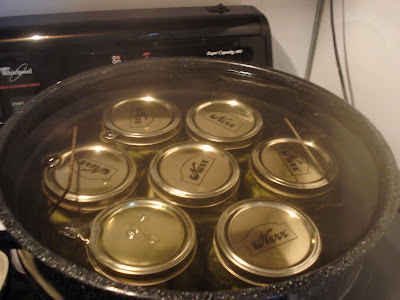
Lately we've added vacuum-sealing to the mix. Pack a jar full of pickles, then cover it tightly enough to keep water out but loosely enough so air won't stay in. Put it underwater and heat it until the contents expand and the air bubbles out. As the jar cools, the vacuum inside it sucks the lid on and you have created a little microcosm of hell. Think about it: Inside the jar is an airless world of burning acid and corroding salt. No one could survive it--not even a bacterium.
As long as one is not a bacterium, though, anyone can make a pickle. It can be done with a minimum of equipment and ingredients. If you are not a canner, you could leave the jars in the refrigerator for a week or more.
Garlic Dills
1/4 bushel cucumbers*
1 bunch dill
2 heads garlic
Fresh cayenne chiles (optional)
The brine:
1 gallon water
1 quart vinegar (5% acidity)
1 cup pickling salt (buy the proper pickling kind - don't use table salt)
* Cukes must go from the vine to the vat in less than 24 hours or they will be soft and disappointing. Buy from a farmers' market and ask the vendor when they were picked!
Put the brine ingredients in a tightly covered pot to boil.
Scrub and halve or quarter the cucumbers lengthwise. Separate the garlic into cloves and peel. Wash the dill and chiles.
Wash and sterilize jars and lids.
Pack the hot jars: 2 cloves of garlic and a sprig or seed head of dill at the bottom, cucumbers and one or two chiles on top, another bit of dill, more cucumbers, and a bit of dill on top.
Slowly pour boiling brine over the cucumbers. Chase out any air bubbles with a table knife. Wipe off jar mouths with a clean cloth, cover with hot two-piece caps, and process in boiling water for 5 minutes. Set the jars on a towel and cover with another towel until cool. Test seals and refrigerate any jars that fail to seal.
Makes around 10 quarts.
Subscribe to:
Posts (Atom)