Showing posts with label garlic. Show all posts

Sunday, May 19, 2013

Flarecorn!


“This is really good. What’s in it? Pickles?”

“I couldn’t have another bowlful, I already ate three.”

“I need some more. The wind blew mine away.”

As it turns out, seasoned popcorn is the perfect festival food. It is easy to make lots, or to make fresh batches here and there all day. Everyone likes it. And the smell of popping corn puts people in a party mood.

I adapted this recipe especially for Art Flare Northeast, which went down in my friend Betsy’s backyard this weekend. If you didn’t make it out there, you should definitely watch this space. Will Art Flare return next year? And will they be serving Flarecorn?

Flarecorn
I made a tenfold batch, then kept the butter warm all day in a baby crockpot and popped the corn as we needed it. The recipe is adapted from Rebar Modern Food Cookbook, which wants you to use Chimayo chile powder. I a) do not have any of that and b) would not make it to serve to random Minnesotan strangers. Oh yah, 6000 Scoville yoonits is kinda hot fer us, don’cha know!

Serves 4-6.

½ stick butter
2 cloves garlic, minced
2 t Hungarian paprika
2 t rubbed sage
Pinch cayenne
½ t salt
½ c popcorn

Melt the butter in a small saucepan over medium-low heat. Toss in the garlic and simmer for a few minutes. Add the spices and simmer for a minute more. Scrape the butter and spices into a big not-plastic popcorn bowl. (Plastic will stain, and plastic + hot fat = bad news.)

Pop the popcorn right into the bowl if you still have one of those old-school air poppers. Take a rubber scraper and toss the popcorn around in the butter, scraping up the butter and seasoning from the bottom, as if you were folding cake batter.

Serve it when everything is about as evenly coated as you can get it.

Sunday, June 10, 2012

Lasagna Is Not an Appropriate Summer Dish


“Why are you making lasagna when it’s 9 billion degrees outside?” tweeted @amycrea, a tweeple who has become an IRL friend. (And who ought to know better than to ask.)

Why? Why?? What do you mean, “why?”
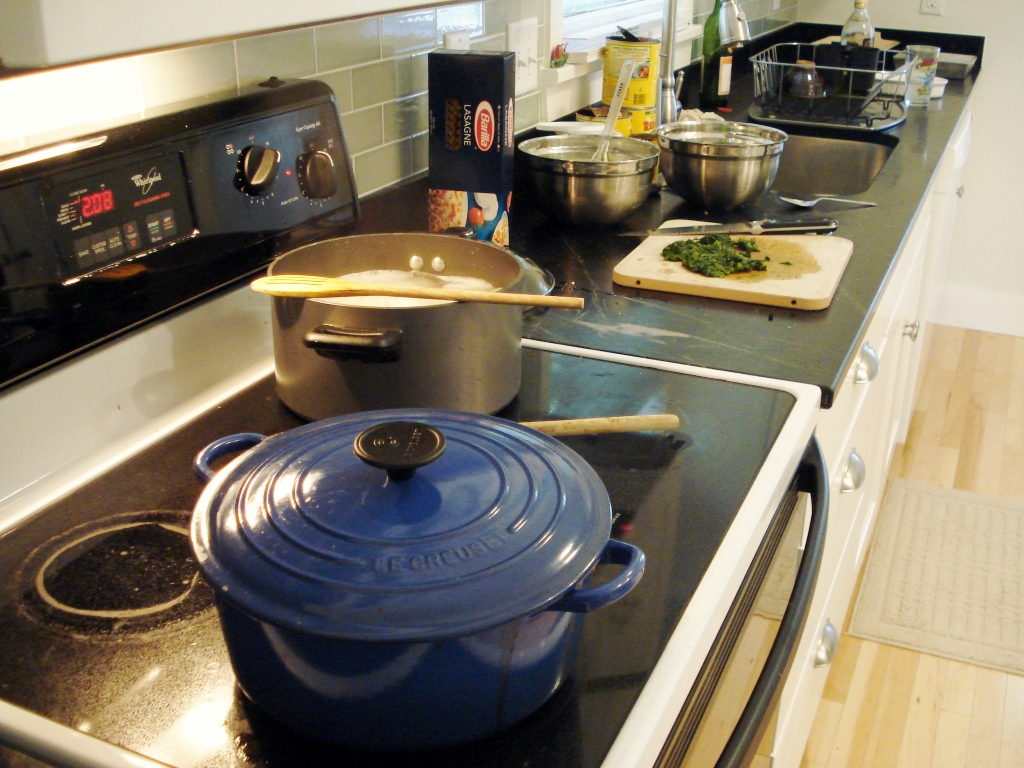
  • I got a new blue Le Creuset earthenware pan for my birthday! Yay! Now I’m feeling adventurous!
  • I read an article about lasagna on Slate.com in a series called “You’re Doing It Wrong.” Nothing pisses me off more than being told by Internet hipsters that I’m doing something wrong. Plus, for someone who’s telling everyone they’re doing it wrong, the author holds a rather shallow understanding of what makes a good tomato sauce. Rrr! Now I’m feeling vindictive!
  • I have promised to bring dinner to my friends Deb and Sean, who are new parents. Now I’m feeling all protective.
So add it up: if you had the whole clear blue sky before you; and THEN you had to one-up someone; AND you could feed it to your loved ones—well, doesn’t that equal lasagna? Weather be damned!

Ridiculous, Ridiculous, Ridiculous
I followed Slate’s suggestion and made mushroom lasagna, except they don’t know what they’re doing so I fixed their recipe. They ARE right, however, about ingredients: get the best stuff you can find. There are three parts to the recipe: sauce, cheese filling, and assembly.

The ingredients PLUS a beadwork snail
Sauce
Olive oil
1 onion, chopped
½ head garlic, chopped
½ to 1 lb mushrooms, chopped
1-2 sage leaves 1 t dried rosemary
3 cans crushed tomatoes
1 can tomato paste
1 cup wine
1 big sprig basil, leaves plucked and torn
Salt and pepper to taste

I overfilled ol' Bluie again. Relax, though, it's a double recipe
 Heat the olive oil in a heavy pan. Sauté the onions and garlic for a few minutes until translucent. Add the mushrooms and continue sautéing until they release, then resorb, their juices. Add the sage and rosemary; then the wine, crushed tomatoes, and tomato paste. Simmer this while you do the next parts, and take your time; it would be best to simmer for an hour. Or more, even! Throw the basil in right at the end before assembly.

Cheese Filling
1 lb fresh spinach
1 lb ricotta cheese
8 oz shredded parmesan, pecorino, asiago, or other dry aged Italian cheese. Hey, shut up. No jokes about my grandma!
1 egg
A dash of freshly grated nutmeg
Salt and pepper to taste

Wash and steam the spinach. Drain it, turn it out onto a cutting board, and chop it. When it is cool enough, squeeze as much water out of it as you can.
Whisk the egg in a medium bowl. Dump in everything else and blend.
Giant mess
Assembly
1 lb lasagna noodles
Olive oil
1 lb mozzarella cheese (fresh or shredded, either is fine.)
Cook the noodles according to the package – I’d throw several tablespoons of salt into four or five quarts of water and boil them in that. Pull them out of the water and drain them, then toss them with a little olive oil to keep them from getting sticky.

Preheat the oven to 375°. (On this, Slate and I agree.) Grease your big old lasagna pan with olive oil, then coat the bottom with sauce. Put down a layer of noodles. Then spread another layer of sauce; drop half the cheese filling in little blobs all over the sauce and smooth it out into a layer as best you can. Put noodles atop this. Do sauce, cheese filling, noodles again. Top with a thin layer of sauce and then cover it up with mozzarella.

Just-a like-a that.
Bake the lasagna until it’s toasty on top and bubbly on the bottom. Watch it carefully, and if it is melted and bubbly but not toasty, you may want to run it under the broiler for a minute or three. Remove the lasagna from the oven and take the time to make a salad before slicing it and serving to acclaim.

Mangiamo!

Sunday, May 20, 2012

Just sayin'

I have been very boring lately, it's true. It's just that I mostly feel eaten alive when I come home from work at night, and the weekends have been filled with the tending of two different gardens. Thankfully, it's farmshare time again. I cooked things! And soon again I will tell you how I made things.


Green garlic, olive oil, and tomato pizza on whole wheat crust

Asparagus, red potatoes, and grilled salmon with sorrel sauce

Pot roast with overwintered parsnips!

Sunday, August 28, 2011

Green Salsa for Lazy People


I have a rule of thumb for salsa: a good recipe has five things in it. Why? Because then I can remember it by counting it off on my hand. I am too lazy to go through life looking up the recipe for something that I should know how to make off the top of my head.

Circular logic aside, I have a convergence of vegetables today: tomatillos, jalapeños, onion, cilantro, and garlic. See? Five things.

Tomatillos usually get cooked, so I will throw them in a pan with water. I will throw in the jalapeños, too. If I were feeling really lazy, I wouldn’t seed them first. I’m going to do it, though, because the people who will eat this with me don’t like too much heat. I may be lazy, but I’m not MEAN and lazy.

Meanwhile I chop up some onion and some cilantro and a clove or two of garlic. How much? Some. Who cares. I’d measure, but I’m too lazy. How fine to chop things? Meh. La-a-a-zy.

Here’s what makes it super lazy: all the things are just going in the blender. I will push a button and then it will be salsa. How much lazier can I get?!

Tomatillo Salsa
A handful of tomatillos, husks removed, rinsed
One or two jalapeño peppers, seeded or not
A clove or two of garlic, minced
A few tablespoons of onion or scallion, chopped
A handful of cilantro, chopped roughly

Put the tomatillos and jalapeños in a pan with water just to cover. Bring to a simmer and cook until the tomatillos turn a dull green and get heated through, about 5-10 minutes. Drain.

Meanwhile, wash and cut up the other three things.


Throw everything in a blender and pulse a few times until everything is roughly blended. You should have chunks and lumps and few worries.

If you need to add a little salt to taste, I won’t tell and I won’t count it as one of the five ingredients.

Monday, December 27, 2010

A Sparklemas Pig


It was love that made me ask. Not chauvinism, not disrespect or failure to acknowledge, understand, or embrace my vegetarian friends. But the pork shoulder was so transcendant and amazing; I simply could not bear the notion that another person might live in the same world with such flavors and miss tasting them.

Thinking it through, I decided the risk of offending them was pretty slight; and, anyway, less weighty than the opportunity to bring this potential experience to their attention.

I called their names. “Are you sure you don't want to expand your definition of ‘vegetable’ to include pigs just for tonight?”

They didn't. They were plenty blissed out on the oven-roasted tomatoes (from Lynne Rossetto Kasper's The Italian Country Table) and the raw kale salad with walnuts, mandarin oranges, and dried cranberries (from the "A Year to Eat Freely" calendar from Kim Christensen's AffairsofLiving.com).

Eh, more for me.

Porchetta
There are, possibly, as many slight variations on this roast as there are families who cook it. My grandmother dictated the instructions to be over the phone many years ago, and I still have the notes I scrawled in red felt-tipped pen on the back of a research request form from the Geography Department at Lerner Publications, where I worked at the time.

Porchetta is pork stuffed with fennel, garlic, and black pepper. How much, you ask? “Some,” I answer. A bunch. Just the right amount. Whatever you think is good. This is a food I know in my heart, not in my head. I chopped up garlic until it looked like enough, ground pepper until I was satisfied. Earlier this year I chopped up and froze the fronds from Harmony Valley fennel. I could have used less, but I felt bad for it because it had been frozen. I wanted it to feel loved. So I broke up the entire quart container I’d preserved. I mixed in the garlic (say about a head of it? Maybe two?) and half the pepper (A handful. Perhaps a quarter cup) and some salt (I dunno. A few tablespoons?).

The dish is made with a pork shoulder or a Boston pork butt. This is the roast made from the thick end of the shoulder. This year, our fabulous 18” snowstorm prevented Tollefson, my favorite pork farmer, from procuring a fresh pork shoulder for me. Instead I chose a pair of roasts to piece together.

A Boston butt (hee hee hee! “Boston butt”) weights three to five pounds; the whole shoulder weighs eight to ten. One pound of this weight is the shoulder bone, which must come out. The flat part of the bone is a piece of cake; one straight slice across the width of the roast and it’s done. The other side, though, is much trickier. Viewed side-on, the bone is shaped like a triangle. From the end, though, it is a T-shaped affair that swoops and curves through the muscle, fat, and connective tissue that make the pork shoulder an incredibly flavorful and tender cut when cooked long and slow.

I finally cajoled the bones out of the roasts. Normally I’d cut two or three layers across the width of the meat, but boning had left me with four big pieces. I butterflied the thick pieces and flattened out the thinner ones. Then I spread my herb mixture over it all. I folded over and shoved together , cramming herbs into every crevice and cut surface. I used four yards of butcher string to tie up the meat any which way I could, ending up with a seven-pound roast.

I mixed the other handful of pepper with some more (another couple tablespoons?) salt and rubbed this mixture all over the porchetta. I wrapped it up tight in foil and put it in the fridge overnight.

The next day, I allowed two hours for the roast to come to room temperature; then started it, still foil-wrapped, in a 300° oven. I used a meat thermometer, since I was planning to cook it for five hours or more. But if I didn’t have one, I simply would have worried less and trusted more. Pork shoulder is so forgiving of overcooking. It is so well marbled and shot through with collagen. I’m not sure what it would take to dry one out. Maybe a volcano. Or someday when the earth consumes the sun. Not my partner’s little gas oven, that’s for sure.

For the last hour and a half, I peeled back the foil and cranked the temperature up to 350° so the meat would brown. I pulled it out of the oven at the five-hour mark, tented it, and let it rest a half hour. At this point, six or eight people suddenly needed to come in the kitchen. Where was the ice? Could they have some water? Did I need any help?

I had to insist, three times and increasingly loudly, that everyone get the hell out of my kitchen.

Finally, we carve. Another fun thing about pork shoulder is the grain: it is meaningless. You can start out cutting across it, but a) it doesn’t matter – the meat is falling-apart tender; and b) it is just going to change direction in about three slices. Do what you can. It doesn’t matter if you are a good carver or a poor one. Everyone is going to have one taste and forget everything except how delicious the meal is.

Buon Scintillina, e mangiamo!

(Happy Sparklemas, and let’s eat!)

Sunday, June 13, 2010

Wagon Scapes


I have never met my friend Kerry, and this recipe is for her.

Last summer I decided to try Twitter. One of the first people I found was one who blogs and tweets as Clue Wagon. We were both new to Twitter, and we quickly discovered that we really enjoy each other’s perspective on life. Go read her blog about genealogy. You’ll see; she’s a mensch.


Clue Wagon and I discovered garlic scapes at about the same time last year, I think. I remember sharing confusion and fascination with this absurdly curly vegetable. We swapped recipes. She sent me a nice pesto. I sent her a sauté of scapes and shrimp finished with white wine and served over cappellini. She told me she’s a vegetarian.

Damn it! I try so hard; I really do. I try to be open to the notion that not everyone will eat everything. I try not to assume. But it did not occur to me to wonder, much less ask, if Clue Wagon was into eating the not-kosher, not-halal, not-vegetable underwater bugs that shrimp essentially are. Crap!

I’ve been thinking about it ever since. Here’s the deal: cooked shrimp are a circle of savory yum. They meet the tooth with just the right amount of resistance. They are salty-sweet and meltingly delicious. I hate the thought of my friend missing out on an ingredient that creates this satisfying burst of flavor, but I’ll be damned if I can’t come up with something that isn’t a dead animal, too.

So, Kerry, please accept this recipe as my love song to vegetarians and food lovers everywhere. You’re at the top of the list.

Wagon Scapes
If you are a vegan, you could make these with gnocchi. It’s so gratifying to bite those. Rrrr!

Pan photo by Beth Berila


1 package cheese tortelloni (2-3 servings)
2-3 T olive oil
1 bunch (10 to 12) garlic scapes
1 bunch(6-8) green onions
½ lb crimini mushrooms
¼ to ½ c white wine, stock, or water
1 sprig each of sage, rosemary, parsley, and basil
Salt and pepper to taste

Set a pot of water to boil. Mince up the herbs. Cut the scapes into ½-inch pieces. Slice the white part of the onions and save the greens for some other use. Slice the mushrooms.

Pop dried tortelloni in the boiling water and give them a bit of a head start. If you’re using gnocchi and you are a multitasker, you can make them at the same time as the scapes. If you’re a one-track cook or you’re using fresh pasta, make them at the end.

Heat the oil in a sauté pan over medium-high heat. Throw in the onions and garlic scapes and stir them around for a minute or two. Throw in the mushrooms. Stir until they release their juices.


Splash some of your liquid into the pan. Keep stirring until reduced and the vegetables are tender. Remove from the heat. Finish your pasta, drain it, and put it in serving bowls. Spoon the vegetables on top. Sprinkle on the herbs and finish with salt and a grind of black pepper.

Mangiamo!

Sunday, August 30, 2009

Pickling: the Art and the Science


For the twelfth year running, I opened canning season on the last Saturday in August. My kitchen filled with steam, vinegar fumes, and business as a small group gathered to enact the mechanical and chemical processes--and the acrobatics of slicing and seasoning--that transform fresh cucumbers into pickles. This ancient art is no less magical for our modern understanding of the science behind it.

Pickling is the artful combination of vegetables, seasonings, and timing. Pickles might be made with one or a combination of flavor-adding preservatives: salt, sugar, vinegar, and fermentation. All pickling methods are essentially a time capsule. The spoilage of food is controlled, repurposed, and all but stopped. Families and communities have passed recipes and preserving methods down through the ages as a matter of tradition.


The science of what people are achieving, though, is brilliant in its simplicity. Long before anyone knew about microorganisms, pickling methods effectively arrested bacterial efforts to decompose food.

Let's break it down: pickling is about solutes, acids, and oxygen. Adding heavy amounts of salt or sugar will desiccate your vegetables. It does the same to many microorganisms, upsetting their chemistry and killing them. The fermenting agents that move into, say, a vat of salted cabbage will begin producing acidic byproducts. These eventually pollute the batch until it is uninhabitable for yeasts (but is sauerkraut for us). Jump-start the process by pouring on an acid like vinegar. Now even fermentation is impossible. Beneath the surface of the pickling fluid, oxygen cannot reach. Microbial life, and therefore spoilage, becomes very difficult.


Lately we've added vacuum-sealing to the mix. Pack a jar full of pickles, then cover it tightly enough to keep water out but loosely enough so air won't stay in. Put it underwater and heat it until the contents expand and the air bubbles out. As the jar cools, the vacuum inside it sucks the lid on and you have created a little microcosm of hell. Think about it: Inside the jar is an airless world of burning acid and corroding salt. No one could survive it--not even a bacterium.

As long as one is not a bacterium, though, anyone can make a pickle. It can be done with a minimum of equipment and ingredients. If you are not a canner, you could leave the jars in the refrigerator for a week or more.

Garlic Dills
1/4 bushel cucumbers*
1 bunch dill
2 heads garlic
Fresh cayenne chiles (optional)

The brine:
1 gallon water
1 quart vinegar (5% acidity)
1 cup pickling salt (buy the proper pickling kind - don't use table salt)

* Cukes must go from the vine to the vat in less than 24 hours or they will be soft and disappointing. Buy from a farmers' market and ask the vendor when they were picked!

Put the brine ingredients in a tightly covered pot to boil.

Scrub and halve or quarter the cucumbers lengthwise. Separate the garlic into cloves and peel. Wash the dill and chiles.

Wash and sterilize jars and lids.

Pack the hot jars: 2 cloves of garlic and a sprig or seed head of dill at the bottom, cucumbers and one or two chiles on top, another bit of dill, more cucumbers, and a bit of dill on top.

Slowly pour boiling brine over the cucumbers. Chase out any air bubbles with a table knife. Wipe off jar mouths with a clean cloth, cover with hot two-piece caps, and process in boiling water for 5 minutes. Set the jars on a towel and cover with another towel until cool. Test seals and refrigerate any jars that fail to seal.

Makes around 10 quarts.


Tuesday, August 11, 2009

Szechuan String Beans


Everybody should have problems like this: I have too much garlic. There’s a bag of fresh string beans in the refrigerator, too. At this time of year, there are string beans everywhere: at farmers markets. In CSA boxes. Spilling out of gardens like a green and yellow tide. But don’t be upset. There’s a solution, and it is Szechuan string beans.

In her Still Life with Menu Cookbook, Mollie Katzen describes her frustration at trying to cook this recipe in a house full of taste-testers. “It’s difficult to accumulate a dinner-sized amount of something when it disappears faster than you can make it,” she writes.

It’s true that if you cook this dish as part of a meal, it will likely have been nibbled away by the time you set the table. The trick, in my opinion, is to make it on a day when you are home alone. Or if you have just fallen in love in the last few minutes, and the object of your affection comes to your house while you are fixing this, then perhaps you will be swept away on a wave of romance and share your string beans with your visitor. The following week, though, things will be back to regular. You’ll be snacking on more than your share by the time your sweetheart rings the doorbell.

I have altered this recipe a tiny bit to include fresh chiles instead of Katzen’s crushed red pepper. The key points are for the wok to be hot and the beans to be dry. It seems like a lot of garlic here, but don’t be scared. High heat knocks the fight out of garlic and leaves it tasting sweet rather than pungent.

Szechuan String Beans

2-3 T sesame oil
2 lb string beans, cleaned
8 cloves of garlic, minced
1 Thai chile, minced
Oh, use more garlic and chile if you like. It’s fun.
½ teaspoon salt

Heat a wok over medium-high heat. Add the oil. Wait for the oil just to begin smoking, and then throw in the beans. Turn the heat to high and stir-fry—that means constant tossing! Keep this up for five minutes or more, until the beans are seared and blistered.

Add the garlic, salt, and chile. Toss, toss, toss some more! Stay at it for another 2 or 3 minutes until the garlic is cooked. Be sure to toss madly so that the garlic doesn’t burn.

Put the beans in your serving dish. You could serve them hot with rice as a main course. You could serve them warm or at room temperature, too, if any are left by the time they cool down.

Enjoy!

Sunday, July 19, 2009

Fennel, once more from the top—with feeling

Even after polishing off a fennel bulb pasta dish, I was still practically cackling with glee over the fennel tops I had left. As the great-grandchild of northern Italian immigrants, I am mindful of the happy marriage among pork, fennel, garlic, and black pepper into porchetta (pronounce it porKETta but don’t let me catch you spelling it that way). I was itching to make this beloved special-occasion dish from my childhood.


I have a recipe (well, it’s more like driving directions) scrawled onto a paper a few years ago while talking to Grandma on the phone. It calls for me to butterfly a Boston butt roast, stuff it with herbs, tie it up with string, and roast it for a few hours. Did I mention it’s July? I’m not roasting. Instead, I’d make the porchetta with a tenderloin, close it up with a kebab skewer, and let it rest overnight. Brilliant! I planned a honey-orange glazed carrot side dish and a small green salad. Then I called my fellow pork-loving Italian-American friend Judy and cajoled her into coming for dinner.


Porchetta tenderloin tasted much like the roasts I remembered: tender, savory pork perfumed with the unmistakable sweet spice of fennel. In absence of long roasting, the garlic was sharp rather than mellow. When it got too intense for me, I scraped the herbs off and let the meat’s flavor sweep me back in time to family gatherings when I was so young my gaze was at tabletop level. I remembered standing eye to eye with plates of cold sliced porchetta to be served in split buttered hard rolls. “This is really good the next day,” I mentioned to Judy around a mouthful. “Next day?!” she said as she speared another slice.


Of course we didn’t get to find out about cold porchetta. I’m afraid we stayed up too late on a work night, drank too much red wine, and ate that whole tenderloin. And I’m not ashamed to suggest that we do it again the very next chance we get.

Buon appetito!


Porchetta Tenderloin

If you’re within driving distance of the Minneapolis Farmers Market, buy from Tollefson’s Family Pork. Best. Pork. EVER.


1 lb pork tenderloin
Fronds from 2 small bulbs of fennel, chopped fine. I guess I had 2/3 cup or more.
3 big cloves of garlic, minced
¼ cup fresh ground black pepper, divided
1 t salt

First, you’re going to butterfly the tenderloin. Well, more like you’re going to caterpillar it. Pretend like you’re going to cut it into medallions about ¾ inch thick. Don’t cut all the way through, though—only about ¾ of the way.

In a small bowl, mix the fennel, garlic, salt, and half the pepper. Stuff some of the mix into each cut. Use it all. Thread a kebab skewer through the tenderloin from end to end, near the top, to hold the butterfly cuts closed. Rub the tenderloin with the remaining black pepper, covering it well. Bundle it up tight in plastic wrap and refrigerate overnight.

Preheat oven to 500 degrees. Unwrap the tenderloin, put in a shallow pan, and cook 20 to 25 minutes. Remove and let stand 5 minutes, pull out the skewer, and cut the slices the rest of the way through. Serve to acclaim.

Should have served 4, but we were being gluttons about it.


Honey-Orange Glazed Carrots

One of my food heroes, Lynne Rosetto Kasper, puts orange zest in her porchetta. I’m not about to mess with my own family’s recipe, but I understood immediately that she’s right. Here's a compromise side dish.

1 lb carrots, peeled and sliced ½ inch thick
2 T butter
2 T honey
½ cup orange juice

Plunk them all in a pan, people. Simmer, covered, for 10 minutes. Then uncover and simmer about 10 more, stirring often. The sauce will reduce to a glaze. Stir to make sure all the carrots are covered.

If you start this and the pork at the same time, they will be done together, too.


Sunday, July 12, 2009

Fennel in Fifteen Minutes Flat


How great is fennel? A fountain of fragrant, feathery green leaves sprouts from the heart of a pale bulb that tastes like no other vegetable in the garden. Having two fennel bulbs AND their fronds feels to me like being rich; I fight the urge to save them all for a special occasion. The fact is, you can’t hoard vegetables. You have to spend them, and the sooner the better.

I’ll cut off the fronds and put them aside for now. Today I'll cook the bulb. It’s delicious roasted, but I can't see my way to roast things on this sunny day in the middle of summer. Besides, that would take soooooooo long, and I'm hungry NOW. I’m going to cook it in butter and serve it on top of pasta.

As it sautés, the fennel fills my kitchen with a spicy-sweet fragrance that makes me think of nothing so much as cookies—particularly, the anise biscotti that my 94-year-old grandmother still makes. The finished dish perfectly balances the sweetness of orange juice and lightly caramelized fennel against the savor of garlic and the warmth of the ginger. The soft richness of the vegetables practically melts onto perfectly al dente pasta. Best of all, it only took fifteen minutes to prepare.

Mangiamo!

Gingered Fennel with Garlic over Pasta

This recipe is modified so heavily from Moosewood Restaurant Low-Fat Favorites (Clarkson Potter, New York, 1996) that the Moosewood Collective would probably disavow it. I would maybe serve this on linguine next time, but whole wheat fusilli is what I had in the cupboard.

You can heat the water while you do the prep work, then boil the pasta while you’re cooking the fennel. Everything will be done together. Hooray!

2 fennel bulbs (mine weighed ¾ pound total)
1-2 cloves garlic, minced
1 tablespoon butter
1 tablespoon grated fresh ginger root
1/3 cup orange juice
½ to 1 teaspoon sugar
Salt and pepper to taste
½ pound dry pasta, cooked al dente

Trim the fronds off the fennel, halve and core the bulbs, and slice thin. I sliced up the stalks, too, because I was feeling greedy and wishing I had even more fennel.

Heat the butter in a heavy pan or skillet. Sauté the fennel for about 5 minutes. It will start to color. Add the garlic and sauté 1 to 2 minutes more.

Turn down the heat, add the ginger root and the orange juice, and simmer until the fennel is tender—about 5 minutes. Take the pan off the heat, sprinkle the sugar over the fennel, and season with salt and pepper.

By now your pasta should be done. Drain it and toss or top it with the fennel. This will make between two and four main course servings.


Monday, July 6, 2009

What the Hell Is Amaranth?


What on earth is this stuff, I wonder. Asking around at my local co-op yields little help. The customer service person checks the Internet and blithely reports, "It's like spinach."

No it ain't, I grumble to myself, as I eye the shock of lurid magenta leaves in my refrigerator.

But I'm not daunted for long. I never met a vegetable I didn't like, and this punk rock spinach impostor is not going to get the best of me. I taste a raw leaf and find it earthy and bitter. Aha. A perfect companion for goat cheese. "I am going to make you into a pizza, little one," I tell the bunch of amaranth.

I'm happy with the result. The taste of amaranth is only vaguely reminiscent of spinach. It's got a bitter undertone, a minerally aftertaste, a flavor that approaches sweetness but shies away at the last minute. I'm hardly doing it justice. It's like if Swiss chard decided to take a Charles Atlas bodybuilding course. Like if spinach and beets finally stopped caring what their parents thought and ran away together to Morocco. Like if kale quit its $300K/yr job and joined an ashram instead.

Do try it.


Amaranth and Chevre Pizza

If you have a pizza stone, put it in the oven while you preheat. If you don't have a pizza stone, then do the first part of the baking on a cookie sheet or pizza pan. Slip the crust off the pan, dress it, and put it right on the rack when you return it to the oven.

The crust:

1 cup white flour
1 cup whole wheat flour
1 package yeast
1/2 t salt

Mix these together. Add all at once:

2 T olive oil
1 cup tepid water (110 degrees F)

Stir together until it is dough. Cover the bowl with a cloth and let rise 25 minutes.

Meanwhile, assemble these things:

A sprinkling of cornmeal or semolina
1 bunch amaranth leaves
1 clove garlic*
1 scallion
1 small chevre (4 ounces is fine)
1-2 T olive oil
Salt and fresh-ground pepper

*I used mild, sweet uncured garlic because it was in the CSA box from Harmony Valley. If you use cured garlic, make it a small clove.

Wash the amaranth and steam it. I shook the water off and put it in a covered bowl in the microwave for 4 minutes, then let it sit another 4 minutes. Press out the excess liquid and chop roughly.

Slice the garlic as thinly as you can. Do the same for the scallion.

Mess up the cheese a little--just make it into chunks that will look pretty on the pizza crust.

Preheat your oven to 400 degrees.

By now your dough should be ready. With floured hands, turn it out onto a floured surface and give it 6 or 10 quick kneads. Press or roll it about a quarter inch thick.

Sprinkle the cornmeal or semolina on your pizza stone, pan, or cookie sheet. Slip the crust onto the sprinkled sheet and bake 10 minutes. Remove from oven, brush the crust with half the olive oil, and dress it: cheese first, then amaranth, then garlic and scallions, then brush these with the rest of the oil. Sprinkle with salt and a grind or five of fresh black pepper. Return to the oven for 10 to 15 minutes.

Let the pizza rest for a couple of minutes before cutting. Mangiamo!

Saturday, July 4, 2009

Beet Greens, Garlic, and Romaine

Yesterday I got a box of CSA goodies with all kinds of wonderful stuff in it! What to cook first?

My sig.o, Beth, wanted fish on the grill; we settled on a simple piece of lake trout. Any fish dinner is begging to be served with plenty of good greens. We decided to start with the beet tops, which are highly perishable, and the romaine. I had a lemon lying around, and it became a key component to the meal.

And what a lovely meal! The beet greens provided an earthy, garlicky complement to the trout. Sweet, crunchy romaine played counterpoint to the tang of feta; and the squeeze of lemon brightened all the flavors. We rounded out the meal with a crusty whole-wheat baguette and a choice between iced tea and pinot grigio.

***


1 bunch beet greens, roughly chopped
1/4 cup fresh garlic (I sliced up the still-soft stem)
1 T olive oil 1/4 c. mirin Salt & pepper
Lemon wedges
Saute the beet greens in the olive oil for 2-3 minutes. Toss in the garlic and cook an additional minute. Add the mirin. Cover and turn down the heat a bit. Cook until tender, maybe 5 minutes. Salt & pepper to taste. Finish with a squeeze of lemon.


1 head romaine lettuce, torn up
1/2 cup crumbled Feta cheese
1/2 cup walnut pieces

Toss with this dressing:
3-5 black peppercorns
1 sprig of fresh thyme
1/3 cup lemon juice
1/4 to 1/2 t grated lemon zest
1 scallion bulb
1 cup olive oil
salt to taste

Put everything except the oil in a blender and pulverize. Drizzle the oil in a thin stream into the running blender.